Collaborative research · Aalto WiT
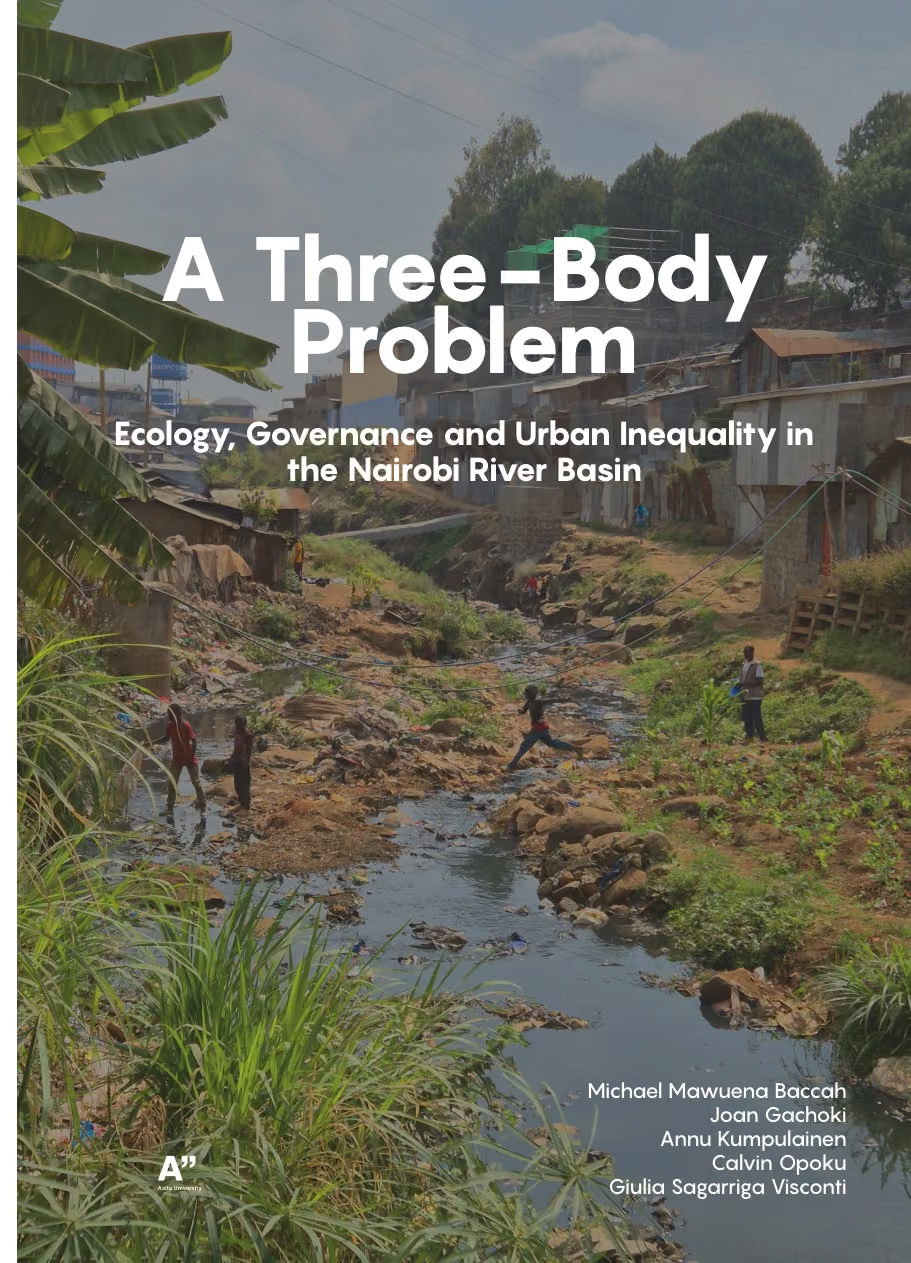
A Three-Body Problem
Ecology, Governance and Urban Inequality in the Nairobi River Basin.
A study of the relationships between river regeneration, urban governance and the communities living along Nairobi’s rivers.
- Location
- Nairobi River Basin, Kenya
- Fieldwork
- 2025
- Publication
- 2026 · Aalto University
- My role
- Co-author · Research, mapping & photography
01 / Research overview
Three bodies. One interconnected basin.
What happens when ecological systems, governance institutions and urban communities pull in different directions?
The report uses the “three-body problem” as a metaphor for the unstable relationships shaping Nairobi’s rivers. Pollution, flooding and displacement emerge from the interaction of infrastructure, political decisions, housing conditions and everyday livelihoods.
Ecology
River health, waste flows, flooding and the limits of urban infrastructure.
Governance
Institutional mandates, planning priorities and the ways decisions are made and enforced.
Communities
Livelihoods, local knowledge and the unequal exposure to environmental harm.
Systems thinking, degrowth, climate justice, pluriversal and insurgent planning inform the analysis. Together, they help connect environmental restoration with questions of power, recognition and social justice.
Read the abstract in the report02 / Fieldwork & methods
Learning along the river.
The 2025 fieldwork brought together institutional perspectives and community experience in Mathare, Kibera, Dandora and Korogocho, alongside visits to sites including Ondiri Wetland.
- Document review
- Academic literature, policy documents, legal frameworks and project reports established the wider context.
- Field observation
- Site visits documented river conditions, infrastructure, public spaces and community-led interventions.
- Stakeholder interviews
- Semi-structured conversations with public agencies, NGOs, community organisations and academic stakeholders explored responsibilities, priorities and barriers to action.
- Participatory mapping
- A walkshop with Mathare Social Justice Centre connected residents’ stories, places of memory and local projects. The material was brought together through qualitative thematic analysis.
03 / Findings
Regeneration depends on the relationships around the river.
The findings connect environmental decline to the way the city is planned, serviced and governed. Four themes run through the research.
Fragmented responsibility weakens collective action.
Overlapping mandates, changing political priorities and inconsistent enforcement limit coordinated work across the basin.
Environmental risk is unevenly distributed.
Gaps in sanitation, waste collection and secure housing place a disproportionate burden on informal and downstream communities. Displacement can move vulnerability elsewhere.
Community initiatives are already doing the work.
Clean-ups, urban agriculture, public spaces and environmental education show local capacity for stewardship. Limited funding, visibility and recognition restrict their wider influence.
Participation needs influence and continuity.
Consultation without follow-through erodes trust. The report calls for sustained collaboration that gives communities a meaningful role in decisions.
04 / My contribution
From field observation to co-creation.
I worked as part of the five-author team, contributing to field research, stakeholder engagement, participatory mapping and photography.
My chapter, Why a Government Mindset Shift Is Essential in Planning for Nairobi’s Informal Settlements, examines how planning attitudes shape exclusion. It argues for recognising residents as partners in urban development and connects the visibility of community initiatives with more collaborative governance.
Read my chapter · Printed pages 90–9505 / A direction for further work
Making community work visible.
The report develops a proposal for an open, collaboratively maintained mapping platform. It would bring community, NGO, academic and government initiatives into a shared view, helping people understand what is happening, who is involved and where efforts could connect.
The framework considers co-creation, institutional stewardship, verification, data ethics and long-term maintenance alongside the interface. It is presented as a proposal for further development. This research also informed my ongoing work on Urban Commons.
Early interface studies from the collaborative report · Printed page 129.
06 / Publication
The complete report.
This page presents an overview of the collaborative research. The complete publication includes the literature review, methods, individual reflections, findings, mapping proposal and references.
- Authors
- Michael Mawuena Baccah · Joan Gachoki · Annu Kumpulainen · Calvin Opoku · Giulia Sagarriga Visconti
- Published
- Aalto University, 2026 · Art, Design, Architecture 2/2026
- Programme
- Aalto WiT Programme 2025 · Department of Architecture, Aalto WiTLAB
- ISBN
- 978-952-64-3026-3
Cite the publication
Mawuena Baccah, M., Gachoki, J., Kumpulainen, A., Opoku, C., & Sagarriga Visconti, G. (2026). A Three-Body Problem: Ecology, Governance and Urban Inequality in the Nairobi River Basin. Aalto University publication series Art, Design, Architecture, 2/2026. https://urn.fi/URN:ISBN:978-952-64-3026-3
Overview adapted from the report. Images retain their original credits and have been cropped or resized for display. The PDF download is a compressed copy of the complete publication.