Modernization Without Empire
How Can Africa Afford the Cost?
Who pays for progress? An inquiry into modernization, urban exclusion and the possibility of development without repeating patterns of exploitation.
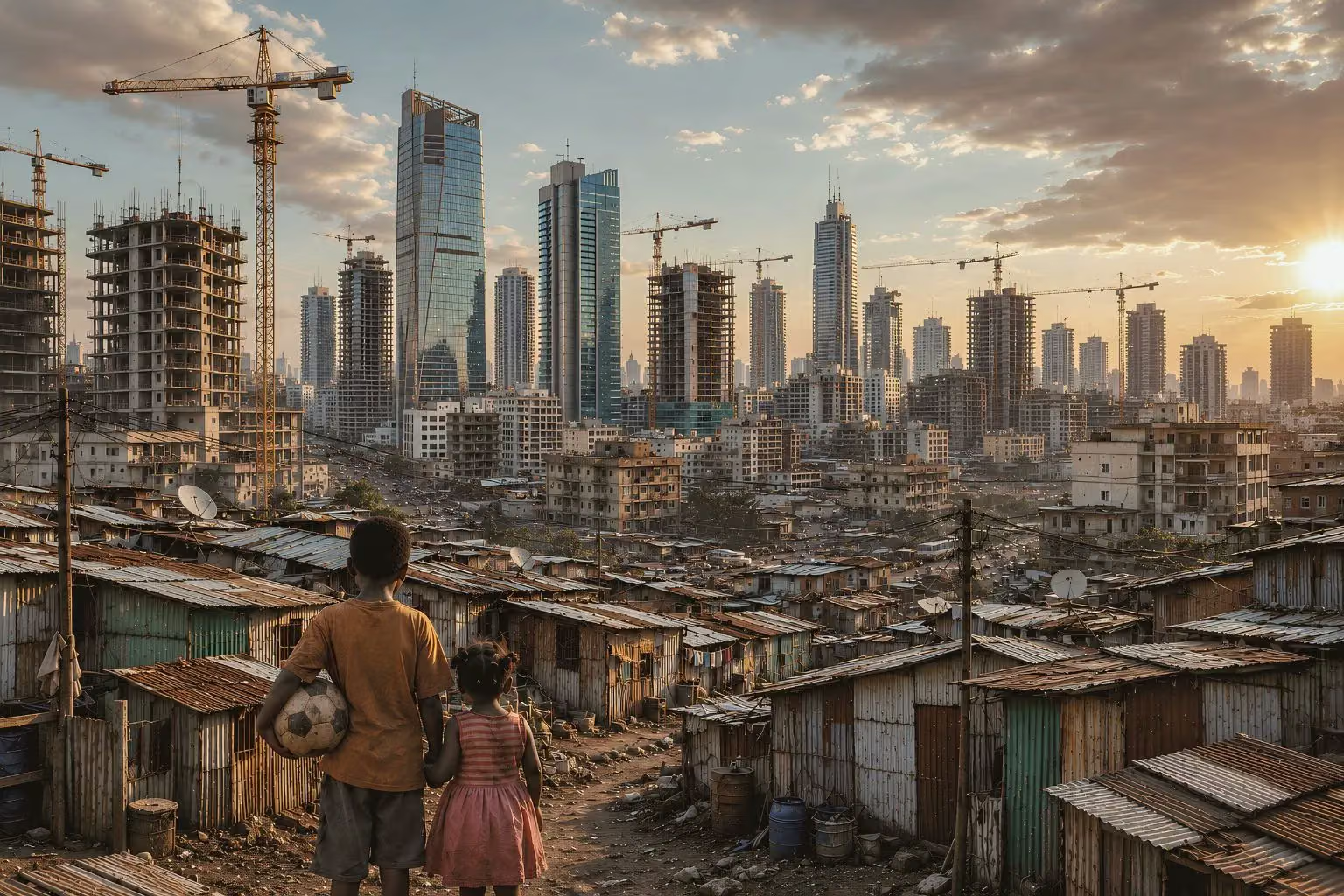
1. Introduction: Africa and the Burden of Modernization
Is development possible without the exploitation of our human resources and the natural environment? Can societies modernize without forcing others to bear the burden of their prosperity? Must every civilization pay for progress through suffering, displacement, inequality, extraction, or sacrifice? And if modernization has always carried a price, who has historically paid it and who continues to pay today?
For centuries, Africa helped pay the price for the modernization of the West. Through slavery, colonialism, resource extraction, and imperial domination, African labor, land, and resources contributed significantly to the rise of Western industrial economies. Even after independence, many of these unequal relationships continued in new forms through foreign extraction, debt dependency, and unequal global economic systems.
Yet despite paying such a heavy historical price, Africa remains structurally vulnerable within the modern world system. Across the continent, cities continue to expand rapidly while millions struggle with unemployment, inequality, poor infrastructure, housing shortages, and rising costs of living. Informal settlements continue to grow around African cities, reflecting deeper issues tied to governance, dependency, and uneven urban development.
Modernization has never been free. While Europe and the United States largely externalized the cost through empire and colonial extraction, many Asian countries that modernized later, such as China, Singapore, and India, were forced to look inward.
Africa still faces this unique dilemma. Infrastructure must still be built, economies must industrialize, and employment must be created for rapidly growing urban populations. If Africa must also pay a price for modernization, should it continue down the same path history has repeatedly shown us, one shaped by suffering, exploitation, inequality, and blood?
2. The Historical Price of Western Modernization
The rise of modern Europe and later the United States did not occur in isolation. The prosperity associated with the Industrial Revolution was deeply connected to slavery, colonial conquest, imperial extraction, and unequal global systems that transferred wealth from Africa, Asia, and the Americas into Western economies.
For centuries, millions of Africans were forcibly removed through the transatlantic slave trade to provide labor for plantations in the Americas. In his book, Capitalism and Slavery, Eric Williams famously argued that profits from slavery played a significant role in financing early European industrial expansion and capitalism. Cotton produced by enslaved Africans became a major driver of textile industries in Britain, while sugar, tobacco, and other plantation commodities strengthened European economies.
Colonialism further expanded this system of extraction. African territories became sources of gold, cocoa, rubber, palm oil, diamonds, timber, and minerals needed to fuel industrial expansion abroad. Colonial infrastructure such as railways, ports, and roads were often designed primarily to move resources from the interior to coastal ports for export rather than to develop local economies or improve African livelihoods (See Figure 2).
The same pattern extended across Asia and the Americas. Much of the environmental destruction, displacement, and social suffering associated with industrial capitalism was absorbed by colonized societies more than by the powers that benefited most from industrial growth. Modernization in the West was therefore built not only on innovation and technological advancement, but also on unequal global relationships that transferred wealth outward from colonized regions.
Africa paid heavily for this process. Beyond the loss of labor and resources, colonialism weakened indigenous industries, distorted local economies, disrupted political systems, and left many African states structurally dependent long after independence.
Many African countries entered the post-colonial era already positioned at a disadvantage within the global economy.
Understanding this history is important because it reveals that modernization has rarely been neutral or evenly distributed. Prosperity in one part of the world was often linked to exploitation in another. The modern global order was built through unequal exchanges of labor, resources, and power. Africa carried a significant portion of that burden.
3. Neo Colonialism and the Persistence of Dependency
Political independence did not end Africa’s dependency on external powers. Although formal colonial rule collapsed across much of the continent during the twentieth century, many of the economic structures established during colonialism remained largely intact. External influence continued through debt dependency, unequal trade systems, foreign extraction, and multinational corporations.
Leaders such as Kwame Nkrumah warned that political independence meant little without economic control. In Neo Colonialism: The Last Stage of Imperialism, Nkrumah argued that foreign influence could continue through economic dependency even after the end of formal colonial rule.
Many African economies still remain heavily dependent on exporting raw materials while importing finished goods and industrial products at far higher value (See Figure 3)
Ghana, for example, remains one of the world’s leading producers of gold and cocoa, yet much of the wealth generated from these resources is realized elsewhere through processing, manufacturing, and global trade. The crisis surrounding galamsey in Ghana for example exposes the tensions between economic survival, environmental destruction, weak governance, and foreign economic influence. Communities search for livelihoods through extraction while environmental damage deepens across many regions.
Neo colonial influence also operated politically. During the Cold War, several African leaders who pursued independent economic or political paths faced destabilization, coups, or external interference. The overthrow of Kwame Nkrumah in Ghana (See Figure 4), the assassination of Patrice Lumumba in Congo, and the death of Thomas Sankara in Burkina Faso remain powerful symbols within African political memory.
These cycles of dependency and instability weakened long-term development across much of the continent. Yet Africa’s challenge today extends beyond resisting external domination alone. The continent must also build institutions capable of long-term planning, accountability, economic transformation, and political stability. Without this, neo colonial dependency risks surviving not only through foreign influence, but also through internal governance failures.
4. Democracy, Governance, and the African Question
Africa’s developmental crisis is also a governance crisis. Since independence, many African states adopted political systems modeled largely after Western institutions inherited through colonial rule. Multiparty elections, presidential systems, and centralized governments were expected to produce stability, accountability, and development. Yet across much of the continent, corruption, policy inconsistency, weak implementation, and political fragmentation continue to undermine long-term transformation.
The problem is not democracy itself, but the assumption that political systems can simply be transferred from one historical and cultural context into another without adaptation. In Citizen and Subject, Mahmood Mamdani argued that many post-colonial African states inherited administrative structures originally designed for control rather than democratic inclusion. Frantz Fanon similarly warned in The Wretched of the Earth that post-colonial societies risked reproducing European political structures without fundamentally transforming the social realities created by colonialism. Colonial borders grouped together diverse ethnic, cultural, and religious communities into centralized states that often-lacked strong national cohesion. As a result, politics in many African states became tied more to ethnicity, patronage, and short-term electoral competition than to national transformation. In The Feasibility of Democracy in Africa, Claude Ake further argued that democracy in many African countries became reduced to elite competition for power rather than genuine social transformation.
This also raises an important question: should Europe automatically be seen as the ideal model for African development? Europe’s rise to modernity did not occur under the same conditions Africa faces today. Its industrial growth was deeply connected to slavery, colonial conquest, imperial expansion, and the extraction of wealth from other societies. Even while many Western nations celebrated democracy, liberty, and human rights, Black populations within those societies often remained politically excluded, and their colonies across Africa, Asia, and the Americas existed under domination rather than freedom. These same powers that continue to promote democratic ideals even today often deny self-determination to the very societies whose labor and resources helped finance their prosperity.
At the same time, Africa cannot ignore the strengths of Western societies that built strong institutions, public trust, educational systems, and social welfare structures capable of improving quality of life and long-term stability, as seen in countries such as Finland, Denmark, and Norway.
Africa’s challenge is therefore larger than simply choosing between Western democracy and traditional structures. The continent must build political systems capable of accountability, stability, inclusion, and long-term development while remaining grounded within African realities and social conditions
5. Modernization Through Internal Sacrifice
Unlike the West, many Asian countries that modernized in the twentieth century could not rely on colonial empires to finance their development. Countries such as China, Singapore, and India were instead forced to look inward, using internal labor, state coordination, industrial policy, and social sacrifice to drive modernization.
Their modernization was driven by urgency. Poverty, weak infrastructure, foreign pressure, food insecurity, and fears of national weakness created intense pressure to develop rapidly. Catching up became tied not only to economic growth, but also to sovereignty, survival, and protection from continued foreign domination.
Singapore presents one of the clearest examples of state led modernization (See Figure 6). Despite having limited natural resources, the country transformed itself through disciplined governance, long-term planning, industrial policy, public housing, educational investment, and strong institutions. Singapore understood that catching up required speed, coordination, and institutional discipline.
In From Third World to First, Lee Kuan Yew himself consistently argued that discipline, institutional efficiency, and long-term planning were essential to Singapore’s survival and modernization.
China followed a far more turbulent path. After decades of internal conflict, foreign occupation, poverty, and famine, China recognized the urgent need to modernize and catch up with stronger industrial powers. Weakness had exposed the country to foreign domination and internal instability for generations. Events such as Opium Crises, Sino-Japanese Wars, the Long March, the Great Leap Forward, and the Great Chinese Famine revealed both the scale of China’s struggles, decline and the devastating consequences of poor planning and failed policies that followed. In response, later reforms under Deng Xiaoping, often referred to as the “Architect of Modern China,” placed enormous emphasis on industrialization, manufacturing, infrastructure, productivity, and long-term economic planning in an effort to strengthen the country economically and strategically.
Yet China’s rise still came with immense social sacrifice. Millions migrated from rural regions into industrial cities to work under difficult conditions, while systems such as the hukou structure reinforced divisions between urban and rural populations and low wage labor became central to the manufacturing economy. Environmental degradation intensified, population control policies emerged, and entire generations endured hardship in the hope that future generations would inherit prosperity and national strength.
India experienced a different but equally complex path. As the world’s largest democracy, it modernized unevenly, combining technological advancement and economic growth with deep poverty, overcrowding, informality, and inequality. Areas such as Dharavi reveal how informal settlements can simultaneously function as spaces of deprivation and economic productivity, where global competitiveness and modernization often exist beside uneven access to development.
Other countries such as South Korea, Japan, and Vietnam also demonstrate how industrial discipline, manufacturing, education, and long-term planning contributed significantly to modernization and national transformation.
These countries offer important lessons in productivity, planning, and state capacity, but their modernization also carried immense human and environmental costs. Africa’s challenge is not simply whether catching up is necessary, but whether development in the twenty-first century must still depend so heavily on sacrifice, inequality, and social suffering.
6. The Internal Colonization of Africa’s Poor
Africa may need to confront an uncomfortable reality. In the pursuit of modernization, development, and catching up, it is gradually beginning to reproduce internally the same systems of exploitation once imposed on the continent through slavery and colonialism. If Africa already understands the historical cost of exploitation better than most societies, then why are these similar patterns emerging internally today?
Informal settlements represent a primary urban reality in Africa, housing roughly 50% to 60% of the continent’s total urban population. Across many African cities, the urban poor have become the invisible foundation upon which modern urban life is built. They are the laborers building our homes, offices, highways, and towers they may never benefit from. They clean apartments they cannot afford, protect gated communities they will never be part of, and provide the cheap and often undervalued labor that sustains urban economies.
Cities such as Lagos, Nairobi, Accra, Kinshasa, Dar es Salaam, and Johannesburg, among many others, reveal these contradictions clearly (See Figure 8). Luxury developments rise beside informal settlements while millions continue to struggle with insecure housing, unemployment, and rising living costs. The same people who sustain these cities through their labor often remain excluded from the prosperity the city represents.
Informal settlements are therefore not simply planning failures. They reflect populations moving toward opportunity within economies struggling to keep pace with rapid urban growth. In Planet of Slums, Mike Davis argued that rapid urbanization across the developing world often produces cities marked by deep inequality and expanding informality. Millions continue moving into urban centers because cities concentrate jobs, infrastructure, education, and opportunity, while rural economies increasingly fail to sustain livelihoods.
As pressure for development intensifies, vulnerable populations increasingly risk being treated less as citizens to be uplifted and more as expendable labor necessary for economic growth. Low wages, displacement, overcrowded living conditions, and exclusion from development begin to mirror older colonial relationships, except the exploitation is now increasingly internal.
The parallels with the colonial era are difficult to ignore. During colonialism, Infrastructure expanded, yet Africans remained excluded from much of the wealth, opportunity, and prosperity created from their own labor and resources.
Today, the political and economic elite increasingly occupy positions once associated with colonial privilege, while large sections of the population continue financing urban growth without fully sharing in its benefits. Modern skylines continue to rise, but many of the people whose labor sustains these cities remain trapped in insecurity and informality (See Figure 10). Modernization cannot simply become the replacement of foreign domination with internal inequality under African leadership. If development continues to depend on the suffering and exclusion of the same populations it claims to uplift, then Africa risks reproducing internally the very systems of exploitation it once fought to escape
7. Why Africa’s Sacrifices Have Produced Less Transformation
Rapid urbanization, economic hardship, political instability, exploitation and the struggles of the urban poor remain widespread across the continent. Yet despite these sacrifices, many African countries have not experienced the same level of transformation achieved by countries such as China, Singapore, South Korea, and India.
Part of the explanation lies in governance, planning, and institutional weakness. While many Asian countries endured difficult paths to modernization, several also combined sacrifice with long-term planning, industrial policy, educational expansion, infrastructural investment, and relatively disciplined state coordination. Development was often treated as a national project tied to productivity, manufacturing, technology, and economic transformation. In her book Reforming the Unreformable, Ngozi Okonjo-Iweala reflected on how corruption, institutional weakness, and political resistance continue to undermine long-term development and reform efforts across many African states.
Governance failure weakens public trust and misuse of public resources create growing frustration among populations already struggling with unemployment and rising living costs. Citizens are repeatedly asked to endure sacrifice for development without confidence that they will eventually share in its benefits.
True modernization is not simply the growth of skylines or wealth for a few while the marginalized are displaced (See Figure 12). It is about improving living standards, expanding opportunity, and allowing ordinary populations to meaningfully share in national progress. Across much of Africa, however, development has often progressed slowly not simply because of limited resources, but because many political and economic elites responsible for decision making already benefit from systems that concentrate wealth and opportunity within small sections of society, reducing the incentive for deeper structural transformation.
Unlike countries that modernized not only to catch up with stronger global powers but also to lift large sections of their populations out of poverty, much of Africa’s elite class has often faced little urgency to fundamentally restructure society in ways that allow the broader populations to benefit from development. Without long-term planning, strong institutions, and inclusive governance, development remains uneven and difficult to sustain.
Many African economies also remain heavily dependent on exporting raw materials while importing higher value industrial and technological products from elsewhere. This limits productive transformation and keeps countries vulnerable within the global economy. In his works, Walter Rodney explained how colonial systems distorted African economies toward extraction, while Samir Amin similarly argued in Unequal Development that many developing economies remained structurally dependent on exporting raw materials while industrial value creation occurred elsewhere.
This is where Africa’s experience differs from many successful modernization stories. Hardship alone does not produce transformation. Without effective governance, productive economies, institutional capacity, and long-term planning, social sacrifice simply reproduces instability, frustration, and underdevelopment.
If Africa is already paying the social cost of modernization through economic hardship, inequality, urban struggle, and political instability, then the continent must begin producing developmental results that reflect those sacrifices. Catching up cannot continue demanding suffering from ordinary populations while progress remains slow, uneven, and concentrated among elites.
8. Can Africa Modernize Without Bloodshed?
One of the greatest tragedies in the history of modernization is that many societies paid for development through violence, revolution, famine, repression, and political instability. China, for example, endured revolution, famine, and social upheaval. Many African states after independence also experienced coups (See Figure 13), civil wars, authoritarian rule, and external interference during the Cold War.
In countries such as Sudan, Ghana, Nigeria, Democratic Republic of the Congo, and Burkina Faso, coups and political instability repeatedly interrupted national development and weakened institutions. External powers often influenced some of these crises when African governments threatened foreign economic or geopolitical interests. At the same time, poor governance within many African states also fueled instability. Corruption, exclusion, weak institutions, and declining public trust created frustration among populations already struggling with hardship and underdevelopment.
However, Africa cannot afford to remain trapped in endless cycles of coups, revolutions, and instability. The urgency to catch up is real, but modernization in the twenty-first century cannot continue to depend on political collapse and bloodshed every time governments fail.
The challenge now is building systems capable of accountability without destroying national stability in the process. Governments must become more responsive, transparent, and development oriented, while citizens and institutions must find stronger democratic ways of demanding accountability without repeatedly collapsing into violence and political disruption.
Modernization in the twenty-first century must depend less on sacrifice through bloodshed and more on institution building, education, technological advancement, productivity, and inclusive growth. Africa cannot continue destroying itself in pursuit of the very progress modernization is meant to achieve.
9. Technology, AI, and Africa’s Chance to Modernize Differently
Unlike previous eras of modernization, Africa now faces a historical moment where technology may provide opportunities to develop differently. Earlier industrial powers relied heavily on colonial extraction, mass factory labor, environmental sacrifice, and long periods of social suffering to modernize. Today, advancements in artificial intelligence, digital technology, renewable energy, automation, and connectivity may allow parts of Africa to leap forward without repeating every stage of historical industrialization.
Artificial intelligence in particular presents both opportunity and risk. AI could improve healthcare, agriculture, transportation, education, governance, and urban planning while helping African societies solve problems more efficiently. AI driven systems when used ethically could help cities better manage traffic congestion, flooding, sanitation, housing, infrastructure planning, public services, and resource allocation. In societies struggling with rapid urbanization, weak institutions, and limited planning capacity, technology may help governments and communities make faster, more informed, and more efficient development decisions if applied ethically and inclusively.
Yet the rise of automation also creates a serious challenge for Africa’s future. Africa’s population is projected to approach nearly 2.5 billion people by 2050, making it one of the largest concentrations of young people in the world. In earlier eras of industrialization, such large populations could become major economic advantages by supplying labor for factories and manufacturing industries. However, automation and artificial intelligence are increasingly reducing the global demand for cheap labor, potentially weakening one of the traditional pathways through which developing societies historically modernized. Earlier industrial powers modernized by absorbing large populations into factories and mass manufacturing, allowing millions to move from poverty into industrial employment.
Achille Mbembe in Out of the Dark Night argued that Africa’s future may depend on its ability to rethink development, technology, and sovereignty beyond older industrial models. This means Africa’s population alone will not automatically produce development. The continent’s growing youth population will only become an advantage if supported by education, digital skills, innovation, research, productivity, and technological literacy capable of integrating large populations into emerging knowledge and technological economies.
The growing global attention toward artificial intelligence in Africa reflects increasing recognition that the continent’s future may depend not only on natural resources or population growth, but also on its ability to participate meaningfully in emerging technological economies.
The Global AI Summit on Africa held in Kigali (See Figure 14) highlighted the growing importance of AI governance, digital infrastructure, technological sovereignty, and innovation in shaping Africa’s future development strategy.
Stronger digital economies, local innovation, technological manufacturing, and AI driven industries could help African countries retain more wealth internally rather than continuously exporting raw resources while importing expensive technologies and finished products.
If managed properly, technological advancement could strengthen economic independence, improve living standards, and support more self-reliant forms of development across the continent.
However, technology alone cannot solve structural inequality. Without good governance, strong institutions, and inclusive policies, technological growth may simply reproduce existing inequalities in new forms. Technology and AI may nevertheless provide Africa with a rare opportunity to modernize more rapidly while reducing some of the human costs that shaped earlier histories of development. The challenge will be ensuring that technological progress strengthens inclusion, productivity, and self reliance rather than deepening inequality and dependency in new forms.
10. Conclusion: Rethinking the Cost of Progress
History shows that modernization has rarely been free. Some societies built their prosperity through empire and colonial domination, while others endured revolution, industrial discipline, political upheaval, and social sacrifice in the pursuit of national development. Africa now faces the difficult challenge of modernizing within a world where many of the old paths to power are no longer possible or acceptable.
At the same time, the urgency to develop remains real. Poverty, unemployment, infrastructural deficits, rapid urbanization, and technological change continue placing enormous pressure on African societies. But if Africa is already paying the social cost of modernization through hardship, instability, inequality, and the struggles of ordinary people, then development must begin producing outcomes that reflect those sacrifices.
The continent cannot afford a future where modernization benefits only political and economic elites while large sections of the population remain excluded from the prosperity their labor sustains. Africa cannot replace external exploitation with internal inequality under African leadership. Development must become a project that improves the lives of ordinary people rather than simply expanding skylines, economies, and political power. Otherwise, modernization risks becoming another system where the many continue to sacrifice so that only a few may rise.
References
- Mbembe, A. (2021). Out of the dark night: Essays on decolonization. Columbia University Press. https://doi.org/10.7312/mbem16028
- Ake, C. (2000). Feasibility of democracy in Africa. Council for the Development of Social Science Research in Africa, Dakar, SN. http://hdl.handle.net/10625/4005
- Eric Williams. (1944). Capitalism and slavery. Chapel Hill: University of North Carolina Press. https://glc.yale.edu/sites/default/files/pdf/capatlism_and_slavery.pdf
- Frantz Fanon. (1961). The wretched of the earth. New York, NY: Grove Press. https://l1nq.com/g61obz8
- Kwame Nkrumah. (1965). Neo-colonialism: The last stage of imperialism. London: Thomas Nelson & Sons. https://www.marxists.org/ebooks/nkrumah/nkrumah-neocolonialism.pdf
- Lee Kuan Yew. (2000). From third world to first: The Singapore story, 1965–2000. New York, NY: HarperCollins. https://sl1nk.com/zrfyirm
- Mahmood Mamdani. (1996). Citizen and subject: Contemporary Africa and the legacy of late colonialism. Princeton, NJ: Princeton University Press. http://hdl.handle.net/10919/65987
- Mike Davis. (2006). Planet of slums. London, England: Verso. https://euroclassworks.com/wp-content/uploads/2015/03/download-mike-davis-planet_of_slums.pdf
- Ngozi Okonjo-Iweala. (2012). Reforming the unreformable: Lessons from Nigeria. Cambridge, MA: MIT Press. DOI: https://doi.org/10.1017/S0022278X14000366
- Samir Amin. (1976). Unequal development: An essay on the social formations of peripheral capitalism. https://sahistory.org.za/sites/default/files/archive-files3/unequal_development_by_samir_amin.pdf
- Walter Rodney. (1972). How Europe underdeveloped Africa: Bogle-L’Ouverture Publications. https://arxiujosepserradell.cat/wp-content/uploads/2022/03/How-Europe-Underdeveloped-Africaby-Recorded-Books-Inc.Rodney-Walter-lib.org.pdf
Beyond the Built / Essay 06
Written by Michael Mawuena Baccah. Originally published by The Archinsight / TAI Publishing House.